
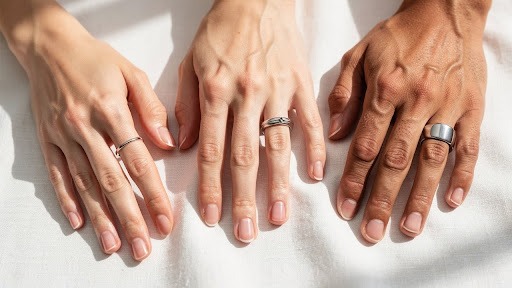
A ring truly captivates when it harmonizes with your hand’s natural beauty. Sometimes the effect feels magical. Other times, despite the ring’s inherent beauty, something feels slightly amiss.
That disconnect typically stems from hand shape. Most shoppers carefully consider metal type, gemstones, and price, yet overlook how a ring interacts with their finger proportions. The same exquisite design that appears delicate on one hand can overwhelm or disappear on the other.
Understanding hand proportions fundamentally transforms the concept of a “perfect ring.” A few elegant principles about finger length, width, and knuckle contours simplify your selection process considerably.
This guide reveals how to identify your hand type, discover which ring styles complement different finger shapes, and select essential details like band width and gemstone cut with unwavering confidence.
Understanding Your Hand Shape and Proportions
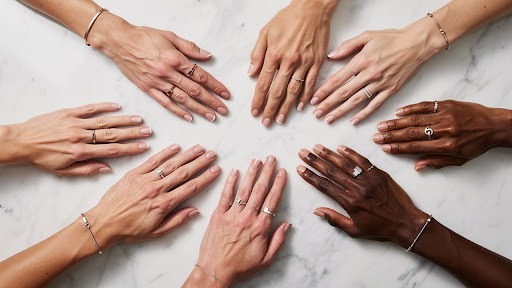
Before comparing styles, know what kind of hand you have. Hand shape is about how long your fingers look next to your palm and how wide each finger appears.
Most people fall into these groups:
- Long, slender fingers – Fingers look longer than the palm is wide and appear narrow.
- Short, petite fingers – Fingers sit closer in length to palm width, giving a compact look.
- Wide or broad fingers – Fingers have more fullness and width, regardless of length.
- Balanced proportions – Nothing stands out as very long, short, slim, or wide.
Place your hand flat on a table and notice whether your fingertips stretch far beyond your palm width or stop closer to it.
Best Ring Styles for Long, Slender Fingers
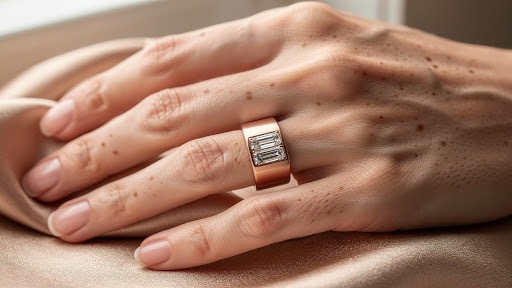
People with long, slender fingers can wear many designs comfortably. The key is balance.
Styles that stretch across the finger work well:
- Wider bands
- Three-stone rings
- East–West settings, where stones lie horizontally
Bold pieces also shine: chunky bands, large stones, Polki rings, and cocktail rings. Details like halos or pavé add richness.
For gemstone shapes, oval, emerald, and marquise cuts elongate fingers, while round, cushion, and princess cuts add width and soften length.
Avoid very thin bands. Most metal shades work well yellow gold, white gold, rose gold, and platinum.
Best Ring Styles for Short, Petite Fingers
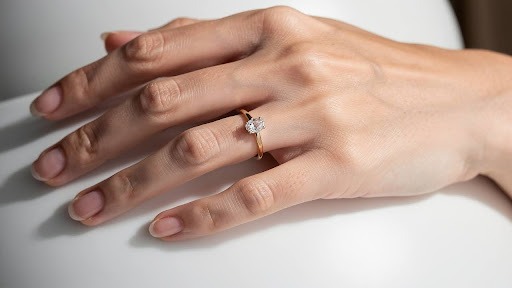
Short, petite fingers look lovely with rings that gently draw the eye toward the fingertip. The aim is to add length without weighing down the hand.
Vertical designs are especially helpful:
- Narrow to medium-width bands
- Ovals, pears, or marquise stones set straight up and down
- Slim bands with a line of small stones running along the finger
These layouts guide the eye from base to tip, giving the impression of extra length.
Clean, delicate styles tend to shine: thin bands in yellow, white, or rose gold, dainty solitaire rings with a single diamond or colored stone, and simple curves with minimal metal. Very wide bands or heavy cocktail rings can compress the finger visually.
A small diamond engagement ring is often ideal for short, petite fingers. A modest stone keeps the design light and proportional while still offering sparkle. When paired with a thin band or a tapered setting, smaller diamonds enhance elegance without overwhelming the hand.
Certain details help: tapered bands that narrow toward the center stone, V-shaped settings that point toward the fingertip, and small to medium gemstones that stay comfortably within finger width.
Best Ring Styles for Wide or Broad Fingers
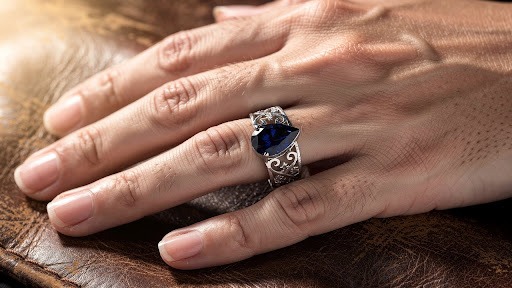
Wide or broad fingers stand out in a striking, confident way. The goal is to balance their width and bring in vertical interest.
Very thin bands often disappear on wide fingers. Instead, look for:
- Medium to wide bands that feel solid and present
- Bands with a domed or court profile for comfort
- Designs with structure rather than a flat strip of metal
Vertical and elongated details work nicely: oval, emerald, pear, or marquise stones set vertically, settings that lift the center stone above the band, and designs that draw the eye along the finger.
Rings with layered detail look especially good: filigree work, open patterns, milgrain edges, textured finishes, side stones, and multi-stone rings such as three-stone or halo designs. These elements create many small lines and points of light. Colored gemstones such as blue sapphire, amethyst, or blue topaz make excellent focal points.
Additional Tips for Choosing the Perfect Ring
Once your hand type feels clear, consider metal color, comfort, gemstone size, and lifestyle.
Skin tone and metal color influence each other:
- Yellow gold pairs well with warm or deeper skin tones.
- White gold and platinum flatter cooler or fair skin.
- Rose gold flatters most skin tones.
Comfort matters as much as appearance. Try different band widths to find what slides on smoothly. Gemstone size should feel balanced small stones disappear on large hands, while large stones overwhelm smaller fingers.
Daily habits shape what works best. If you use your hands frequently, choose lower settings, durable metals like platinum or 18k gold, and secure bezel or channel settings. For stacking rings, ensure they sit flush together.
Conclusion
Choosing a ring becomes simpler once hand shape is part of the conversation. When you know whether your fingers are long and slender, short and petite, or wide and broad, each design detail starts to click. Long fingers can carry wider bands and bold designs, short fingers shine with slim, lengthening rings, and wide fingers look striking with medium to wide bands that add vertical detail.
The best ring is not just the sparkliest option in a display case. It is the design that rests on your hand and feels natural, balanced, and true to your style. For some, that means a plain gold band. For others, it might be a classic solitaire, a colorful gemstone ring, or an ornate Polki piece.
With awareness of your hand shape and a willingness to try several designs, the process stays enjoyable and personal. The right ring becomes more than jewellery it becomes a small, shining part of how you see yourself every day.